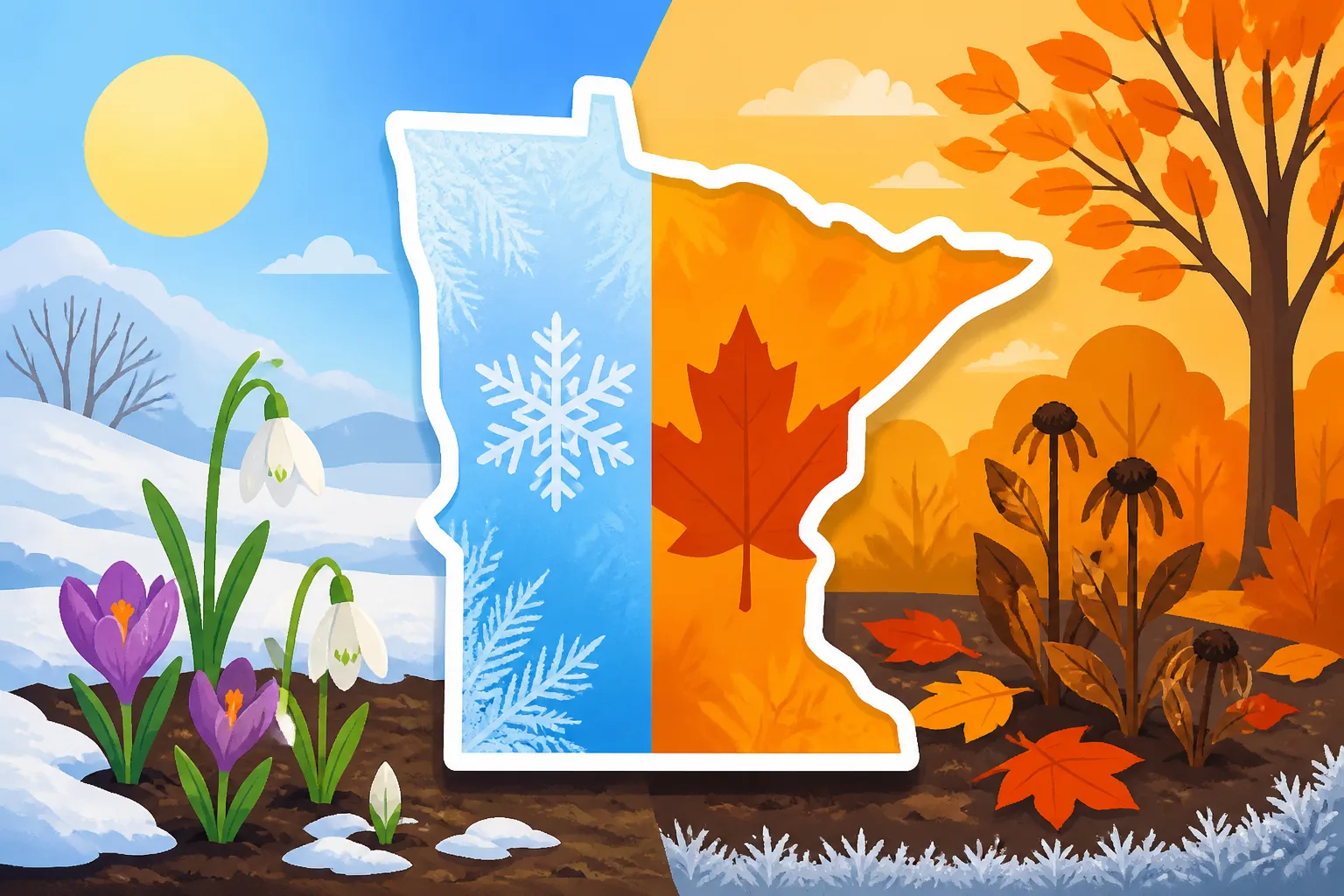
Minnesota Frost Dates: Tracking Spring Thaw and Fall Freezes
Minnesota gardeners often want one date that says when spring planting is safe or when the growing season is over. Frost dates can help frame those decisions, but they are probabilities tied to weather stations—not promises for every yard. Here’s how to read the dates, use them to plan around risk, and adjust for your garden’s soil, location, and current conditions.
What frost dates mean—and what they do not
A spring frost date and a fall frost date mark points in a seasonal risk pattern. A spring date estimates when a specified temperature is likely to occur for the last time in the season. A fall date estimates when it is likely to occur for the first time. They are useful reference points, but they cannot tell you exactly what the weather will do this year.
The dates also describe a particular temperature threshold. In the figures below, that threshold is 32°F. A date tied to that threshold is not a complete measure of all cold injury risk. Plants differ in their sensitivity, and a light frost, a longer cold spell, and a hard freeze do not have the same effect on every plant.
A frost-date estimate is best understood as a planning boundary, not a planting instruction. It can help you compare the relative risk of planting at different points in the season, but it does not account for everything that matters in a garden. Soil may still be cold or wet in spring even after the air has warmed. A sheltered bed may behave differently from an exposed one. A forecast can also change quickly.
The useful question is therefore not simply, “What is my frost date?” It is, “What does the date tell me about the risk, and what other conditions should I check before I act?” That distinction helps prevent a common mistake: treating a calendar entry as a guarantee that tender plants will be safe outdoors.
| Term | What it describes | How to use it |
|---|---|---|
| Last spring freeze | A statistical estimate of when a specified freezing temperature occurs for the final time in spring | Use it to frame spring risk, not as an automatic planting date |
| First fall freeze | A statistical estimate of when a specified freezing temperature occurs for the first time in fall | Use it to think about crop protection and harvest planning |
| Probability | How often an event occurred within the observations used to calculate a date | Choose a probability that fits your tolerance for risk |
| Local conditions | Differences in exposure, soil, slope, and nearby structures or vegetation | Use them to refine a regional or station-based estimate |
Minnesota Department of Natural Resources explains that the freeze-date tables are based on the 1991-2020 period of record. That means the tables summarize observations from that period; they are not a forecast for a particular spring or fall.
Minnesota Department of Natural Resources describes spring and fall freeze-date probabilities as historical probability calculated from past temperature observations. The probability is about how often the temperature event occurred in the historical record, not a promise that it will happen—or stop happening—on the listed date in the current year.
That distinction matters most when you are deciding whether to risk an early planting. A date with a higher likelihood of being past the final spring freeze may offer a more cautious planning point, but it still cannot remove the chance of a late freeze. A date with a lower likelihood of being past it may be useful to someone willing to protect plants or accept setbacks. The official table is the place to compare the available probabilities for your location; do not assume that one probability level fits every crop or gardener.
For a closer look at broader seasonal decisions, see Minnesota Garden Timing: Knowing When to Plant or Hold Off. Frost dates are one part of timing, alongside conditions that change from bed to bed and from one week to the next.
How to read Minnesota’s probability-based dates
A date paired with a probability is more informative than a date by itself. Without the probability, it is easy to read a frost date as if it were a fixed boundary: before it, frost is certain; after it, frost is impossible. Neither interpretation is sound.
A 50% probability is a midpoint estimate based on the observations used to calculate it. In practical terms, it indicates that the event has occurred on one side of that date in about half of the relevant observations and on the other side in about half. It does not say that there is a 50% chance of frost on every day around that date. Nor does it mean that the listed date will divide the current season neatly into safe and unsafe periods.
At the Minneapolis/st Paul Airport weather station in Minnesota, NOAA National Centers for Environmental Information gives the 1991–2020 normal last spring freeze (32°F) at 50% probability as 04/23 (April 23).
At the Minneapolis/st Paul Airport weather station in Minnesota, NOAA National Centers for Environmental Information gives the 1991–2020 normal first fall freeze (32°F) at 50% probability as 10/18 (October 18).
These station figures are useful reference points for the area represented by the station. They are not an exact forecast for every garden in the Twin Cities, much less every location in Minnesota. A weather station records conditions at its site. Your garden may be more exposed, more sheltered, lower, higher, closer to a body of water, or surrounded by surfaces that affect how it warms and cools.
When reading a table, make sure you know which temperature threshold it uses and which probability is attached to the date. Do not compare dates from different thresholds as though they describe the same event. Likewise, do not compare a cautious probability for one season with a midpoint probability for another and assume the resulting span is a reliable measure of your own growing season.
The table below offers a practical way to translate the idea of probability into garden decisions without treating any date as a guarantee.
| If you are using the date to… | Consider… | Avoid… |
|---|---|---|
| Plan an early spring planting | Whether the crop can tolerate cool conditions and whether you can protect it | Assuming the midpoint date makes all planting safe afterward |
| Set out tender plants | Recent and upcoming forecasts, soil conditions, and a backup plan | Using a frost date as the only decision rule |
| Estimate fall harvest risk | Crop maturity needs, harvest priorities, and protection options | Assuming the first freeze will arrive exactly on the listed day |
| Compare nearby garden sites | Exposure, low spots, wind, shade, and built features | Treating a station date as an address-specific prediction |
The probabilities are especially useful for choosing how cautious to be. A gardener with a small number of precious seedlings may prefer to wait for stronger evidence that cold risk has eased. Someone growing a crop that handles cool weather, or someone with dependable protection, may make a different choice. Neither approach changes the historical probability; it changes how you respond to it.
For more help weighing a forecast against calendar timing, see Weighing May Frost Forecasts Before Moving Tender Plants Outdoors. Forecasts can help assess near-term risk, while the frost-date table provides historical context. They answer different questions, so it is useful to consult both rather than treating either as a substitute for the other.
Spring thaw is not the same as the last spring freeze
The phrase “spring thaw” can sound like one clear event, but a garden does not move from winter conditions to planting-ready conditions all at once. Snow can recede, daytime temperatures can rise, and the surface of a bed can look workable while the soil below remains cold or saturated. A frost-date table does not measure whether your garden soil is ready to dig, seed, or transplant.
That difference is important because spring planting decisions involve several kinds of readiness:
- Air-temperature risk: Could a cold night damage the crop?
- Soil temperature: Is the seedbed warm enough for the crop to germinate and grow?
- Soil moisture: Is the soil workable, or will digging and planting compact it?
- Plant tolerance: Can the crop handle cool weather, or is it sensitive to cold?
- Protection and flexibility: Can you cover, move, or delay plants if conditions change?
The last spring freeze figure speaks to only one of those concerns. Even if the probability date has passed, a wet, cold bed may still be a poor place for a seed or transplant. Conversely, some cold-tolerant crops can be planted before tender crops are ready, provided the soil and local conditions are suitable.
Do not confuse “the soil has thawed” with “the soil is ready to work.” A simple check is to assess how the soil behaves when handled. If it clings in sticky clumps or smears easily, working it can damage its structure. Waiting for better conditions may protect the bed and make planting easier. For more detail on that decision, see When Is Minnesota Garden Soil Dry Enough to Work? and Testing Garden Soil for Sticky Spring Moisture Before Digging.
Soil warmth also varies by crop. A cold-hardy seed may germinate in a bed that is unsuitable for a warm-season crop. The calendar and frost table cannot replace crop-specific temperature needs. If you are deciding when to sow, compare the expected soil conditions with the crop’s requirements rather than relying only on the last-freeze estimate. Minnesota Soil Warmth and Frost Timing for Vegetable Seeds explains how to bring those considerations together.
Match the timing to the crop
For spring planning, separate crops into practical groups rather than treating the whole garden as a single planting project. Cool-tolerant crops may be suitable for an earlier window than plants that need warmer air and soil. Tender crops are more vulnerable to cold and may need to wait, be protected, or be grown from transplants held back until conditions improve.
That is a general distinction, not a substitute for crop-specific guidance. Seed packets and reliable growing instructions can help you identify temperature needs, maturity expectations, and whether a crop is typically direct-sown or transplanted. In Minnesota, regional differences also matter. A schedule that fits one part of the state may not fit another.
The Minnesota Vegetable Planting Calendar by Region can help you think beyond a single statewide date. If you are deciding whether to start a particular crop indoors, use Indoor Seed Timing and Outdoor Planting for Minnesota Brassica Crops or the relevant crop-specific article, rather than translating the frost date directly into a sowing date.
Separate “safe from frost” from “ready to grow”
A plant can escape frost damage and still struggle if the soil is too cold, the site is waterlogged, or the plant has not adjusted to outdoor conditions. Transplants that move abruptly from a protected indoor setting into outdoor sun, wind, and temperature swings may be stressed even when a freeze is not forecast.
Hardening off helps bridge that difference by gradually acclimating seedlings to outdoor conditions. It does not make a tender plant frostproof, but it can reduce the shock of the move. Use crop-appropriate guidance for the process, and keep an eye on the forecast while plants are adjusting. The article Hardening Off Minnesota Vegetable Starts Without Stalling Growth covers that transition in more detail.
If a cold night is in the forecast, the right response depends on the crop, the forecast conditions, and the protection available. A cover may help reduce exposure, but no cover should be treated as a guarantee without considering how it is installed, whether it is secure, and what conditions it is designed to handle. Use Extending the Minnesota Growing Season with Cold Protection to compare protection approaches and their trade-offs.
Using the fall freeze date to plan harvest and protection
The first fall freeze estimate helps you think ahead before cold weather becomes urgent. It is not a countdown clock. The first freeze may arrive earlier or later than the midpoint estimate, and a garden’s actual exposure can differ from the weather station’s. Use the date to prompt planning rather than to set a rigid end date for every crop.
Start by identifying what you want to protect and what can be harvested before cold becomes a concern. Some vegetables tolerate cool weather better than others. Some crops can be harvested while young, while others need more time to mature. If you are growing crops with a long development period, compare their expected maturity needs with your likely fall window and keep an eye on the season as it unfolds.
A useful fall plan includes a few decisions made before the forecast turns cold:
- Which crops are most vulnerable to a freeze?
- Which crops are close enough to harvest that protection may be worthwhile?
- Which crops can be harvested early if the forecast worsens?
- Do you have covers or other protection ready to use?
- Is protection practical for the bed, or would harvesting be the better option?
Thinking through those choices in advance is more helpful than treating the first-freeze date as a day on which everything must be picked. It also reduces the chance of improvising when weather conditions change.
For crops planted late in the season, maturity time matters as much as the frost-date estimate. A crop that needs substantial time to develop may not be a good fit for a late planting, even if the first fall freeze is not yet near. On the other hand, a fast-growing crop may still be worth sowing when there is enough favorable weather for it to produce a useful harvest. A fall planting calendar can help compare those options; see Minnesota Fall Vegetable Planting: Timing Late-Season Crops and Calculating Crop Maturity Days Against Minnesota Autumn Freeze Dates.
Protection can extend the window, but it has limits
Row covers, low tunnels, cold frames, and other structures can reduce exposure and help plants cope with cool conditions. They do not erase the season’s weather risk or make every crop suitable for outdoor growing through a freeze. The protection method needs to match the crop and the expected conditions, and the structure must be managed as temperatures change.
Light can become a consideration under covers, while heat can build during sunny periods. Covers may also need to be opened or removed when conditions change, particularly for crops that need access to pollinators. These are practical trade-offs: protection may help preserve a crop, but it can also add work and require attention.
Do not assume that a product or homemade structure provides a particular level of protection unless its instructions support that use. Follow product directions and crop-specific recommendations. Using Cold Frames and Low Tunnels to Extend the Vegetable Season compares approaches, and Balancing Sunlight Loss and Frost Defense with Minnesota Row Covers discusses one common trade-off.
Let the forecast update the plan
The historical date helps frame the season, but a short-range forecast is more relevant when deciding what to do tonight or over the coming days. A forecast can warn you about an approaching cold event, but it still has uncertainty. Check it as the planting or harvest decision approaches, and be ready to adjust.
If a vulnerable crop is still outdoors, make a practical choice based on its condition, the forecast, and your ability to protect or harvest it. If the crop is unlikely to benefit from protection, harvesting may be the more dependable option. If it is close to maturity and protection is suitable, covering it may buy useful time. There is no single response that fits every garden.
Why one Minnesota frost date does not fit every garden
A statewide planting decision cannot be reduced to a single weather station. Minnesota covers a broad area, and conditions vary across the state. A station-based frost date is a regional reference, not a precise prediction for a particular yard. Local geography and the layout of a garden can shift exposure enough to make two nearby beds behave differently.
A low area where cold air collects may be more vulnerable than a slope or a site with good air movement. An open garden may cool differently from a bed beside a building or under a tree canopy. Wind exposure, shade, nearby water, and hard surfaces can all affect how a site warms or loses heat. These effects do not create a guaranteed “safe” microclimate; they are reasons to observe your own space and avoid assuming that every part of it matches the station.
Start by noting which areas are consistently early or late. Where does snow tend to linger? Which beds dry first after rain? Which areas are exposed to open sky, and which are sheltered? Where have plants experienced cold damage before? These observations can help you make more informed decisions next season, especially when used alongside current forecasts and official frost-date data.
Avoid turning a small observation into a fixed rule. A sheltered wall may warm quickly on a sunny day but still be exposed to a cold night. A bed that has been frost-free in past years may not remain so every year. Microclimates adjust risk; they do not cancel it.
Use the right location and regional context
When using a frost-date table, select the location or station that is most relevant to your garden, while remembering that no station reproduces every yard. If the official source provides several locations or probabilities, compare the entries that best match your area and your tolerance for risk. Do not fill in missing data by borrowing a date from another location or treating a regional average as an exact address-specific estimate.
Regional gardening calendars are useful because they incorporate differences in seasonal timing across Minnesota. For broader context, see Northern Versus Southern Minnesota: Adjusting Planting Schedules and Minnesota Vegetable Planting Calendar by Region. They can help you avoid applying a schedule from a distant part of the state without adjustment.
Hardiness zones can help with a different kind of decision, but they should not be confused with frost dates. A plant’s hardiness rating concerns its ability to survive winter conditions, while a spring or fall freeze estimate helps describe seasonal temperature risk. Neither one guarantees success in a particular location. For the distinction, see Understanding USDA Plant Hardiness Zones for Minnesota Gardens and Why Plant Hardiness Ratings Do Not Guarantee Winter Survival.
Keep a garden record
A simple record can improve decisions over time. Note when the soil became workable, when you planted, when cold caused damage, and which parts of the garden were affected. Record how plants responded to protection and whether a bed repeatedly warmed or dried earlier than others. The goal is not to replace official observations with a few seasons of personal notes, but to learn how your site differs from the regional reference.
Keep observations specific. “The sheltered bed stayed warmer than the open bed during a cold night” is more useful than “spring was early.” Recording the crop, bed location, and conditions helps you notice patterns without overstating what one season can prove.
A garden record can also keep you from repeating a poor timing choice. If a tender crop repeatedly struggles when planted early, the issue may be cold exposure, soil warmth, or transplant stress rather than the calendar date alone. If a fall crop rarely matures before cold weather, consider an earlier sowing, a more suitable crop, or a protection method in a future season.
Turn frost dates into a flexible planting calendar
Frost dates are most useful when they guide a sequence of decisions instead of dictating one. A practical calendar begins with the seasonal risk estimate, then adds crop needs, soil conditions, forecast updates, and the limits of your site. That approach leaves room to change plans when spring or fall behaves differently from the historical average.
Use this sequence as a planning framework:
- Choose a reference point. Find the relevant station or official table and note the temperature threshold and probability. Make sure the location is a reasonable regional comparison for your garden.
- Sort crops by cold tolerance. Separate cool-tolerant crops from tender ones. Use crop-specific instructions for when to sow, transplant, or protect each group.
- Check the bed itself. Assess soil moisture and warmth before planting. Do not work saturated soil merely because a calendar date has arrived.
- Watch near-term forecasts. Recheck conditions as a planting or protection decision approaches. Historical probability and short-range forecast information serve different purposes.
- Choose a risk level. Decide whether you would rather wait, protect plants, or accept a chance of damage. The right choice depends on the crop and how costly a setback would be.
- Review the plan during the season. Move planting or harvest tasks when conditions warrant. A calendar is a tool for organizing work, not a promise that weather will follow it.
This framework also helps with succession planting. Rather than sowing every crop at once, you can spread plantings when suitable conditions persist, keeping the weather and crop maturity in view. For late-season planning, Succession Planting for Autumn Harvests Before Cold Minnesota Nights can help connect planting windows with the approach of fall cold.
Make separate decisions for seeds and transplants
Direct-sown seeds and transplants face different conditions. Seeds rely on suitable soil conditions to germinate, while transplants must adjust to outdoor weather and establish roots after being moved. A frost date may be relevant to both, but it cannot tell you whether a seedbed is warm enough or whether a transplant is ready to leave a protected setting.
For seeds, consider crop-specific soil warmth and moisture. For transplants, consider hardening off, nighttime conditions, and how quickly the plant can establish. A transplant that looks large indoors is not automatically ready for the garden. Likewise, a date that seems late by the calendar may still be too early for a heat-loving crop if the soil remains cool.
If you are choosing between starting seeds indoors and buying transplants, consider how much control you want over timing and how much space and attention you can provide seedlings. Starting Vegetable Seeds vs Buying Transplants for Minnesota Gardens can help weigh that decision.
Prepare for both early and late seasons
Spring and fall planning work better when they are connected. Choosing crops that suit the length of your likely growing window, staggering sowings, and keeping protection materials ready can make the season more flexible. The aim is not to chase the earliest possible planting or the latest possible harvest at any cost. It is to match crops and effort to the conditions you can reasonably manage.
For an early start, focus first on crops that tolerate cool conditions and beds that are workable. Use protection only when it is appropriate and manageable. For fall, plan backward from the crop’s maturity needs while recognizing that the first freeze is uncertain. If you rely on a single date, you may leave too little time to respond when the season runs early or late.
A calendar can still provide structure. Put likely tasks in a broad order, then update them as the season develops. Keeping the plan flexible is not a failure of scheduling; it is the sensible response to a weather-dependent activity.
Frequently Asked Questions
Does a frost date tell me the exact day to plant?
No. A frost date is a probability-based reference for a particular temperature event. Planting also depends on crop tolerance, soil condition, forecast risk, and whether you can protect plants.
Is the listed spring date a promise that frost is over?
No. The date summarizes historical observations at a probability level. A freeze can still occur later, so check forecasts and consider the vulnerability of the crop before planting.
Why might my garden have a different frost experience from a nearby station?
A weather station represents its own site, while yards differ in exposure, elevation, shelter, and cold-air movement. Use station information as regional context, then pay attention to patterns in your own garden.
Should I use the same frost date for every vegetable?
No. Crops vary in cold tolerance and soil-temperature needs. Use crop-specific guidance and make separate decisions for cool-tolerant plants and tender crops.
What should I do when a fall freeze is forecast?
Assess which crops are vulnerable, how close they are to harvest, and whether suitable protection is available. Depending on those factors, covering or harvesting may be the better choice.
Sources
- NOAA National Centers for Environmental Information — NOAA NCEI 1991–2020 Climate Normals — Minneapolis/st Paul Airport, Minnesota (checked November 14, 2026)
Disclaimer
This article is for general informational purposes only and does not constitute professional advice. Laws, prices and regulations vary by location and change over time. Consult a qualified professional for guidance on your specific situation. Minnesota Gardening Guide is not a government agency and is not affiliated with any university extension, state department of agriculture or other government agency.